

For decades, the advice was simple: if your back hurts, buy the hardest mattress you can find. It's the kind of thing grandparents still say with total confidence. In this first entry of our Sleep Lab series, we're putting that advice under the microscope, because the science of spinal support turns out to be a lot more interesting than "harder equals better."
The myth: a rock-hard mattress is always better for your back
The logic sounds reasonable on the surface - a firm, flat surface should keep your spine "straight" all night. But your spine isn't straight when you're standing, and it shouldn't be forced straight when you're lying down either. It has a natural S-curve, and a mattress that's too firm doesn't support that curve, it fights it.
The bust: what actually happens on a too-firm mattress
Lie on a genuinely hard surface and your shoulders and hips - the widest, heaviest parts of your body, take almost all the pressure, because nothing beneath them gives way. Meanwhile, your lower back, which curves inward, is left floating with no contact at all. Your muscles spend the night compensating for that gap instead of relaxing, which is often why people wake up stiffer than when they went to bed.
It's about zonal support, not maximum hardness
The better framework is "zonal support": different parts of your body need different amounts of give at the same time. Shoulders and hips need enough softness to sink in slightly and stay pressure-free. Your lower back and midsection need firmer support directly underneath so the spine doesn't sag out of alignment. A single slab of hard foam can't do both jobs, you need engineered layering.
How this plays out across our ranges
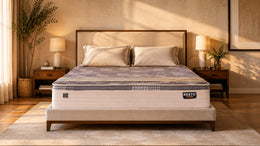
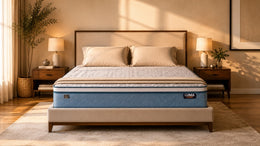
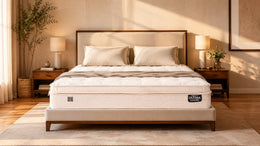
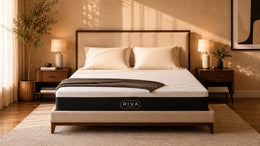
This is exactly why we don't build one mattress and call it a day. Sova pairs a high-density Posture Bond support core with softer comfort foam on top, so the base resists sagging under weight while the surface still relieves pressure points. Resto takes a similar approach with its Enduro HR support layer topped by softer quilting, firm where it counts, cushioned where it touches you. Ultima and Riva go further with additional comfort layers for sleepers who want more contouring without losing that structural base underneath.
The verdict
Your spine is a curve, not a plank, and it should be supported like one. The right mattress for back pain isn't automatically the firmest one in the shop, it's the one that supports your lower back while still giving your shoulders and hips somewhere to sink in. That balance is what to feel for, not just how hard the surface feels when you press down with your hand.
Wondering which mattress suits you?
Compare the Foamico ranges and find the feel that matches how you sleep.
Explore Mattresses