

All mattresses eventually sag — the question is how many years you get before that happens. Here's a quick reference on how the main materials compare, and what determines whether a mattress hits the top or bottom of its expected range.
Quick comparison
| Material | Typical Lifespan |
|---|---|
| Natural latex | 12–20+ years |
| High-density memory foam | 8–12 years |
| Hybrid (foam + spring) | 7–10 years |
| Innerspring | 5–8 years |
Natural latex — the longest-lasting option
Latex resists sagging better than almost any other material, thanks to its naturally elastic, compression-resistant structure. It's also breathable, which helps it age well even in warm rooms. The trade-off is a higher upfront price — but spread over 15–20 years, the cost-per-year is often lower than cheaper alternatives that need replacing twice in that time.
High-density memory foam
Density is the number that matters most here — a higher-density foam softens more slowly and holds its shape longer. Premium memory foam layers, like the ones used in Sova and Ultima, are chosen specifically for this reason rather than for cost.
Hybrid (foam over springs)
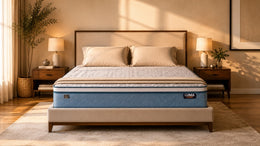
Lifespan here depends on both the coil quality and the foam density above it. Luma's pocket-spring core is built to hold its bounce for years without the coils losing tension prematurely, which is often where cheaper hybrids fall short.
Innerspring
The shortest-lived of the common options — springs gradually lose tension and the comfort layer on top compresses faster than foam or latex equivalents. Fine as a budget option, but expect to replace it sooner.
What actually determines durability
- Foam density or coil gauge — higher is almost always more durable
- Your body weight and how concentrated the pressure is
- Whether the bed base actually supports the mattress properly
- Regular rotation, roughly every 3–6 months
Wondering which mattress suits you?
Compare the Foamico ranges and find the feel that matches how you sleep.
Explore Mattresses

